Cross-Cutting & Institutional Development: Building Sustainable Systems for Impact
-
by
DGVS
At Dehati Gramothan Vikas Samiti (DGVS), sustainable social change requires strong organizational foundations, continuous capacity building, and active community participation. Our Cross-Cutting and Institutional Development Program focuses on strengthening organizational systems, improving staff capabilities, and enhancing community engagement practices. By integrating strategic cross-cutting elements across all our interventions, the program builds a skilled workforce and efficient operational processes that contribute to the long-term sustainability and impact of social development initiatives.
Through regular training and capacity-building activities, program staff and community facilitators are equipped with the technical knowledge and practical tools required to implement complex projects effectively. The program promotes participatory approaches that encourage active community involvement in planning, execution, and decision-making processes.
Understanding Cross-Cutting Features in Development Projects
In institutional and social development, cross-cutting features refer to essential principles and practices that overlap across multiple thematic areas rather than remaining confined to a single program. At DGVS, these features include gender sensitivity, environmental sustainability, financial transparency, and child protection.
Instead of treating these core values as isolated initiatives, we embed cross-cutting features directly into every project framework—whether we are driving Community Development drives, running primary education campaigns, or managing local healthcare centers. This ensures that every initiative delivers comprehensive and ethically grounded outcomes for the community.
Addressing Core Cross-Cutting Requirements for Sustainable Impact
To achieve long-term success, social welfare organizations must satisfy specific cross-cutting requirements across all operational levels. These requirements act as standard quality benchmarks that every project must meet before, during, and after execution.
Key cross-cutting requirements include:
-
Inclusivity & Equity: Ensuring marginalized groups, including women and elderly individuals, have equal access to project benefits.
-
Capacity Building: Continuously upgrading the technical and managerial skills of field staff and local coordinators.
-
Robust Monitoring & Evaluation: Establishing standardized data collection and assessment tools across all active programs.
-
Resource Optimization: Maximizing the impact of organizational resources across diverse programs like Rural Development and vocational training drives.
Fulfilling these requirements ensures organizational resilience, accountability to donors, and measurable social impact on the ground.
Implementing a Unified Cross-Cutting Approach Across Programs
A structured cross-cutting approach allows DGVS to break down operational silos and connect distinct development sectors under a cohesive vision. Rather than viewing education, healthcare, and livelihood as separate fields, a cross-cutting approach addresses them as interconnected elements of human development.
For example, when establishing Self Help Groups (SHGs) for economic empowerment, our cross-cutting approach simultaneously incorporates Healthcare Initiatives, legal rights awareness, and guidance on Girl Child Education. This multi-dimensional strategy maximizes resource efficiency and ensures that community development efforts are holistic, resilient, and deeply impactful.
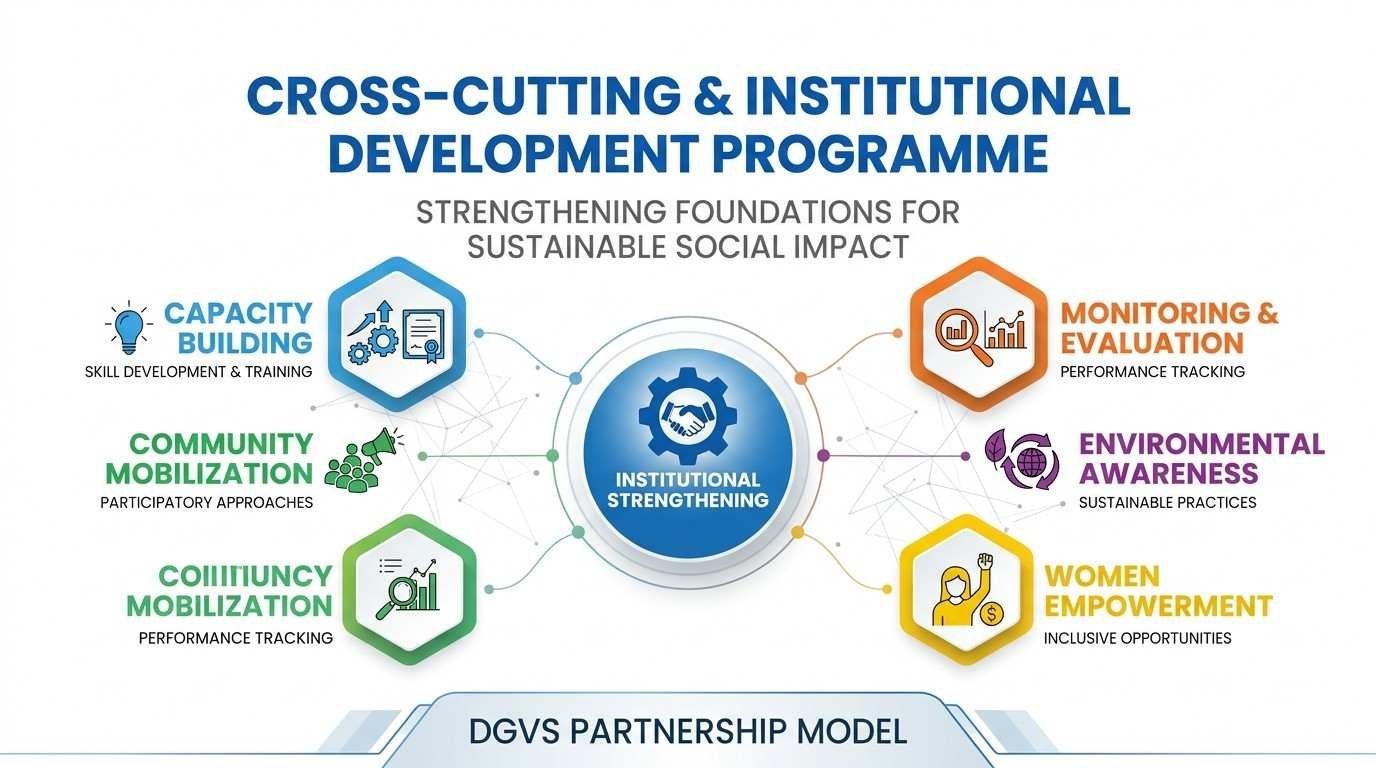
Key Focus Areas of the Program
Our institutional framework focuses on four primary pillars designed to enhance operational excellence and community ownership:
1. Capacity Building of Staff Across Programs
Enhancing the technical knowledge, leadership skills, and professional competencies of project staff. Continuous training empowers field coordinators to address complex field realities with confidence and efficiency.
2. Community Mobilization Techniques
Strengthening community participation and fostering collective action for local development. Mobilization strategies are regularly integrated into grassroot programs to drive self-reliance among women and local youth.
3. Monitoring & Evaluation (M&E) Practices
Improving project tracking, performance measurement, standardized reporting, and impact assessment. Data-driven M&E mechanisms ensure transparency and help adapt strategies based on ground feedback.
4. Participatory Rural Appraisal (PRA)
Engaging local communities directly in identifying their own needs, mapping available resources, and formulating solutions. This ensures that interventions are culturally aligned and community-owned.
Target Beneficiaries & Key Stakeholders
The Institutional Development initiative works directly with individuals and groups responsible for driving transformation at the grassroots level:
-
Program Staff: Equipping them with modern management and execution skills.
-
Community Facilitators: Building their capacity to lead local awareness and mobilization drives.
-
Field Coordinators: Strengthening their monitoring, documentation, and reporting capabilities.
-
Community-Based Organizations: Empowering local committees to independently sustain social efforts.
-
Local Community Leaders: Training village heads and influencers to advocate for inclusive progress and welfare.
Expected Outcomes and Long-Term Impact
By institutionalizing strong cross-cutting practices across all operational levels, the program achieves measurable, long-term outcomes:
-
Improved Organizational Effectiveness: Enhanced program quality and streamlined field operations.
-
Enhanced Professional Competency: Continuous skill upgradation for program teams and field coordinators.
-
Stronger Community Ownership: High community involvement leading to long-term sustainability of local initiatives.
-
Evidence-Based Decision Making: Robust M&E structures providing reliable data for continuous improvement.
-
Holistic Social Upliftment: Effective integration of cross-sectoral goals within broader Social welfare programs across target regions.
Frequently Asked Questions (FAQs)
1. What is a cross-cutting concept?
A cross-cutting concept is an overarching theme, principle, or practice that applies across multiple operational areas, topics, or sectors rather than being confined to a single isolated project. In development work, concepts like gender equity, sustainability, and capacity building act as cross-cutting elements across all projects.
2. What are examples of cross-cutting issues?
Common examples of cross-cutting issues in social development include gender equality, environmental sustainability, human rights, disability inclusion, governance, and institutional capacity building. These issues impact every sector—from healthcare to education—and must be integrated universally.
3. What are some examples of cross-cutting themes in education?
In the education sector, cross-cutting themes include digital literacy, gender equity in classrooms, environmental awareness, inclusive learning for children with special needs, and life-skills training alongside traditional academic subjects.
4. What are 8 cross-cutting issues commonly addressed in development?
Eight widely recognized cross-cutting issues in social welfare and development include:
-
Gender Equality & Women Empowerment
-
Environmental Awareness & Climate Action
-
Human Rights & Child Protection
-
Institutional Capacity Building
-
Disability Inclusion & Accessibility
-
Good Governance & Transparency
-
Youth & Skill Development
-
Community Health & Hygiene
5. What is the purpose of cross-cutting?
The main purpose of a cross-cutting approach is to ensure that critical perspectives—such as sustainability, equity, and efficiency—are not treated as secondary thoughts. It ensures holistic project planning, avoids duplication of efforts, and maximizes the overall impact of development programs.
6. What are the seven cross-cutting concepts?
In general scientific, educational, and analytical frameworks, the seven core cross-cutting concepts include:
-
Patterns: Observing recurring events or structures.
-
Cause and Effect: Understanding mechanisms and explanations.
-
Scale, Proportion, and Quantity: Assessing measures of size, time, and energy.
-
Systems and System Models: Defining boundaries and operational inputs/outputs.
-
Energy and Matter: Tracking flows, cycles, and conservation.
-
Structure and Function: Analyzing how shape or design determines properties.
-
Stability and Change: Understanding conditions that affect system balance over time.